

Talas pneumáticas: um dispositivo simples, mas que só funciona se usado corretamente.


Autor
Experimente a diferença da Xiamen Tianzuo Medical – onde cada produto é um testemunho da nossa dedicação à saúde e à segurança.
Marie R. Winters


Vamos começar com uma cena real.
Você está no local. Um paciente apresenta suspeita de fratura no antebraço. Ele está com dor. Precisa ser removido do local.
Você pega uma tala inflável. Enrola-a em volta do corpo. Enche-a com ar.
Tem boa aparência. Transmite segurança.
Mas cinco minutos depois, você verifica novamente. A tala parece mais macia. A imobilização não está tão apertada. O que aconteceu?
Essa não é uma história rara. E nem sempre é erro do usuário. Às vezes, o problema está na própria tala.
O que é, de fato, uma tala pneumática?
Um tala de ar é basicamente um manga de plástico ou vinil de parede duplaVocê o envolve em torno do membro lesionado, o infla com uma bomba ou com a boca (sim, alguns modelos permitem isso) e ele endurece o suficiente para estabilizar a fratura.
Sem dobradiças. Sem fivelas complicadas. Apenas pressão do ar.
Essa simplicidade é o seu maior trunfo. Mas é também onde as coisas dão errado.
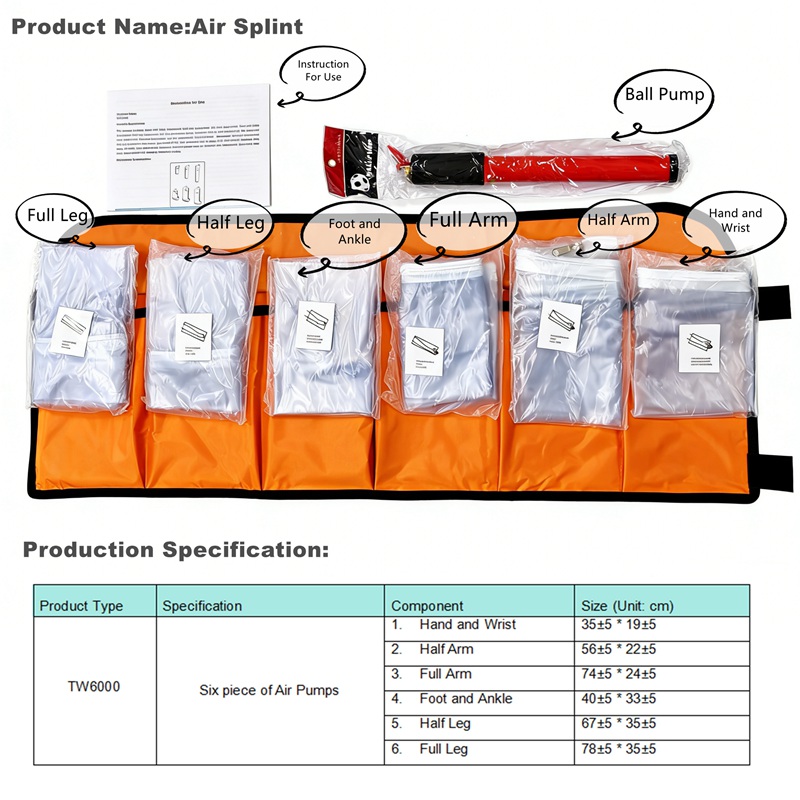
Os dois problemas mais comuns que observamos
Fabricamos talas pneumáticas. Também recebemos ligações de distribuidores que perguntam: "Por que meus clientes estão reclamando?"
Em noventa por cento dos casos, é uma dessas duas opções.
1. Vazamentos lentos
Algumas talas perdem a pressão após 10 a 15 minutos. Não porque o usuário tenha feito algo errado, mas sim porque a soldagem da costura não era forte o suficiente.
Você não percebe isso quando infla pela primeira vez. Mas depois de alguns minutos? O membro começa a se mover novamente. Isso anula todo o propósito.
Boas talas mantêm a pressão por pelo menos 30 minutos sem precisar de ajustes. As ruins? Você vai precisar bombear a cada poucos minutos.
2. O zíper ou o velcro cedem
A tala em si pode estar boa. Mas o fechamento falha.
O velcro entope com sujeira e não cola. Os zíperes emperram ou quebram no meio do caminho.
Aí você fica com uma tala perfeitamente inflada que não para de enrolar. Frustrante, né?
Por isso usamos zíperes reforçados e tiras de velcro extragrandes nos nossos produtos. Parece um detalhe pequeno, mas na prática faz toda a diferença.
Onde as talas de ar são realmente utilizadas?
Não apenas ambulâncias. É aqui que as vemos com mais frequência:
| Contexto | Uso típico |
|---|---|
| Serviços médicos de emergência (EMS) | Estabilização da fratura antes do transporte |
| Medicina esportiva | Lesões à beira do campo — tornozelo, pulso, antebraço |
| Clínicas e pronto atendimento | Imobilização temporária durante a preparação para o gesso. |
| Hospitais militares e de campanha | Opção leve e compacta para ambientes remotos. |
| kits de cuidados domiciliares | Para famílias com idosos com risco de queda |
Portanto, mesmo que você não esteja vendendo para grandes hospitais, ainda existe um mercado.
O que observar ao comprar talas de ar
Se você está adquirindo esses produtos para revenda ou uso clínico, esqueça o marketing sofisticado. Confira estas opções.
✅ Resistência da costura
Este é o principal ponto de falha oculto. Costuras frágeis = vazamentos lentos.
Pergunte ao seu fornecedor: Qual é o seu processo de soldagem? Se ele não souber responder com clareza, tenha cuidado.
✅ Qualidade da válvula
A válvula é por onde se bombeia o ar. Válvulas baratas vazam. Ou são difíceis de operar com luvas.
Faça o teste. Bombeie. Deixe agir por 20 minutos. Verifique novamente.
✅ Opções de Tamanho
Os conjuntos padrão geralmente incluem:
Tala para braço (para antebraço e pulso)
Tala para perna (para a parte inferior da perna e tornozelo)
Tala para tornozelo/pé (menor)
Se um fornecedor oferece apenas um tamanho, pergunte porquê.
✅ Translúcido aos raios X? Talvez nem sempre.
Alguns compradores solicitam talas radiotransparentes (para que não seja necessário removê-las para radiografias). Mas nem todos os mercados exigem isso.
Conheça primeiro o seu cliente. Não pague por funcionalidades que ninguém pediu.
Uma breve palavra sobre reutilização.
A maioria das talas de ar são reutilizáveis, desde que sejam limpas adequadamente.
Mas eis o que os distribuidores nem sempre lhe dizem: sangue ou fluidos corporais podem entrar na bomba ou na válvula. Portanto, a menos que o projeto permita uma limpeza completa, algumas instalações as tratam como de uso único para um único paciente.
Se você estiver vendendo para ambientes com alto risco de infecção (pronto-socorro, UTI, ambulâncias), considere oferecer versões descartáveis ou fáceis de limpar.
Nossa opinião (sem enrolação)
As talas pneumáticas não são de alta tecnologia. E não precisam ser.
Mas elas precisam reter o ar e permanecer fechadas. Todo o resto é secundário.
Já fabricamos esses produtos há tempo suficiente para saber onde os custos são reduzidos. Nós não economizamos nesses custos.
Se isso for importante para você — seja você um comprador de hospital, um distribuidor ou um instrutor de serviços médicos de emergência — vamos conversar.
Deseja as especificações ou uma amostra?
Podemos enviar-lhe:
Catálogo de produtos com tamanhos e materiais
Relatório de ensaio sobre resistência da costura e retenção de ar
Uma unidade de amostra (se você estiver falando sério)
Basta entrar em contato. Nada de enrolação com "preencha um formulário e espere três dias".
- Como usar um espirômetro de três esferas: um guia prático para a recuperação respiratória pós-cirúrgica.
- Como escolher um imobilizador de cabeça: um guia de compras B2B para serviços de emergência médica e hospitais.
- Cânula Nasal de Alto Fluxo (CNAF): Como Funciona e Quando Optar por Ela em Vez de uma Máscara de Oxigênio Padrão
- Cânula nasal de oxigênio: a ferramenta silenciosa e essencial da oxigenoterapia (e como especificá-la corretamente)
- Tala pneumática versus gesso: qual dispositivo de imobilização escolher?
- Máscara Venturi versus máscara sem reinalação: qual dispositivo de administração de oxigênio você deve escolher?
- Máscara laríngea (LMA) versus tubo endotraqueal: como escolher a via aérea correta
- Como escolher uma máscara CPAP: Facial completa vs. Nasal vs. Almofada nasal (Guia do comprador 2026)